
|
|
|
|
|







Delegated Commissioner Seeks License Revocation, $5 Million Penalty Against Retail Supplier For Alleged Deceptive Practices
The following story is brought free of charge to readers by VertexOne, the exclusive EDI provider of EnergyChoiceMatters.com
Massachusetts DPU Commissioner Cecile Fraser, in the capacity of Delegated Commissioner, has issued a Notice of Probable Violation against CleanChoice Energy, Inc.
The Delegated Commissioner's Notice of Probable Violation proposes a $5 million civil penalty and a revocation of CleanChoice's license for what the Delegated Commissioner alleges are, "egregious misconduct and a pattern of misconduct," in
violation of various applicable statutes and rules
Kate Colarulli, spokesperson for CleanChoice Energy, provided the following statement concerning the matter:
"CleanChoice Energy develops, constructs and finances clean energy projects, and we sell clean power to consumers across the United States. We are proud of that record of clean energy delivery for our customers. We will cooperate with the DPU on any inquiries they have."
--- Statement from Kate Colarulli, spokesperson for CleanChoice Energy
The Notice of Probable Violation does not represent final action by the DPU, and CleanChoice has 30 days to respond to the notice
Among other things, the Delegated Commissioner alleged that CleanChoice's pricing, and CleanChoice's disclosures, contracts, and marketing governing such pricing, were unfair and
deceptive as defined by the Massachusetts Attorney General's retail energy market rules at 940 CMR 19.00. The DPU requires competitive suppliers
to comply with the Attorney General’s regulations
With respect to eight customer complaints which, in part, prompted a review leading to the Notice of Probable Violation, the Delegated Commissioner alleged that CleanChoice's electricity supply products have a three-month fixed
introductory price, which then renews to a variable monthly price if the customer does not cancel
service or choose a new product.
The Delegated Commissioner alleged, "CleanChoice’s contract summary form provides that 'your
price is subject to change monthly, based on market conditions and CleanChoice Energy’s costs
to provide energy supply service'"
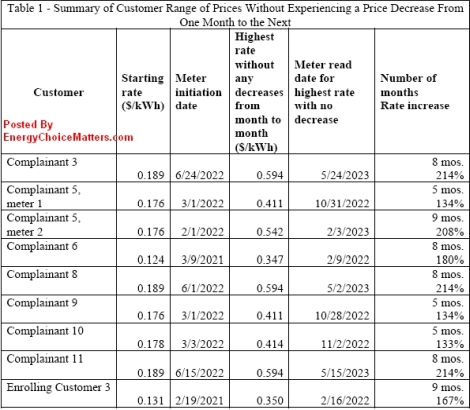
The Delegated Commissioner alleged, "For these eight customers, the introductory prices ranged from approximately 12 to
19 cents per kWh. Following the expiration of the fixed-rate introductory period, these
customers were placed on a monthly variable price that increased each month for five to nine
months. Following these multiple months of price increases, these customers were charged
prices between 34.7 and 59.4 cents per kWh or price increases between 133 percent and
214 percent."
The Delegated Commissioner alleged, "The highest prices charged to these customers are, in and of themselves, concerning.
However, it is the number of months that these customers were charged a variable price, which
only increased, that concerns me here. CleanChoice represented that its prices are subject to change monthly 'based on market conditions and CleanChoice Energy’s costs.' Typically,
market conditions, energy costs, and seasonality would cause the electricity supply price to
increase and decrease over time. That did not happen for these customers."
The Delegated Commissioner cited the following alleged rate increases experienced by the relevant customers, with no decreases during such period:
The Delegated Commissioner alleged, "Accordingly, CleanChoice’s contract summary form, and contract, conflicted with
CleanChoice’s actual business practice of raising prices regardless of market conditions and its
energy costs. CleanChoice’s contract summary forms and contract were inaccurate and
deceptive."
The Delegated Commissioner further alleged, that, due to such allegedly inaccurate and
deceptive summary forms and contracts, "these customers’ election of the Respondent’s product was not transparent
or informed, thus nullifying any manifestation of affirmative choice made by customers that received these contract summary forms and contracts."
"Accordingly, CleanChoice did not receive
affirmative customer consent and, thus, unlawfully provided each customer with supply service.
G.L. c. 164, § 1F(8)(a)(i); 220 CMR 11.05(4)(a)," the Delegated Commissioner alleged
The Delegated Commissioner similarly alleges that further alleged instances of deceptive practices, detailed below, also constitute slamming for the same reason (the customer's election was not transparent
or informed)
The Delegated Commissioner further alleged that various statements in CleanChoice's marketing were deceptive
The Delegated Commissioner alleged, "The Respondent [CleanChoice] provides disclosures regarding its variable prices in its direct mail
advertising materials -- 'Your variable rate may be higher than your utility rate or other
suppliers’ rates' -- and in its contract summary form -- 'your future monthly prices may be
higher or lower than the introductory price' []. Although the disclosures provide customers with a generic warning of the
product’s price volatility, the direct mail advertising material and contract summary form do not
provide any information regarding the potential extreme magnitude of the Respondent’s variable
price levels, as discussed [above]. Before enrolling, prospective
customers are not informed of the monthly variable price(s) in effect at that time, prior history of
monthly variable prices, nor any warning that its monthly variable prices could be significantly
higher than the price offered for the fixed introductory price period. Following enrollment, the
Respondent does not notify customers of the expiration of the introductory price nor what the
customer’s variable price will be."
The Delegated Commissioner alleged, "Additionally, for three customers who called the Respondent to enroll after receiving
the direct mail adve1iising material, the sales agents did not disclose that at the end of the
introductory period the Respondent's prices could be subject to extreme increases. Quite to the
contrary, each of the three sales agents made claims that the enrolling customers would benefit
from the Company's pricing after the introduct01y period. CleanChoice's sales agents made
these representations despite not having any way to know what the Respondent's prices would be
in the future."
The Delegated Commissioner alleged, "The Respondent's marketing practices are inaccurate and deceptive. The marketing
agents misrepresented the true outcome of CleanChoice's fixed- to variable-rate products, which
invariably led to much higher prices than customers were told to expect, rather than the lower or
stable prices promised. The lower introductory priced product and methods of selling it
constitutes a short-term 'teaser' product to entice customers to enroll with CleanChoice. After the introductory fixed-price period, customers are switched to a monthly variable price that
rapidly increases to levels that can be two or three times the price of basic service prices,
competitors’ offers, or even CleanChoice’s own fixed price offers. The Respondent’s business
practice lacks sufficient warning prior to purchasing, lacks notification of extreme price changes
following enrollment, uses false disclosures regarding causes of price increases (as described ... above), and permits its sales agents to mislead prospective customers into enrolling.
These misrepresentations induced customers to enroll in CleanChoice’s product offerings to their
detriment. In my view, the practice creates a false impression for reasonable consumers about
the price of the product following the introductory period."
The Delegated Commissioner alleged that, for a number of customers whose fixed rates expired at different times, CleanChoice increased each of such customers’ expiring fixed price by approximately
18 percent for the first month of the contract’s variable month-to-month pricing component
The Delegated Commissioner alleged that, for such customers, the contract summary form states, "your price is subject to change monthly,
based on market conditions and CleanChoice Energy’s costs to provide energy supply service."
The Delegated Commissioner alleged, "The term 'market conditions' indicates a tie to market prices and related costs incurred
by the Respondent. Yet, the Respondent increased prices by approximately 18 percent for the
first month of variable month-to-month pricing for customers that had different introductory
prices. One would expect the price increase for customers with different introductory prices to
have different percentage increases after the introductory offer once the Respondent accounts for
market conditions and its costs. Further, the 18 percent price increase did not occur due to
market seasonality because the increases occurred during different months for different
customers []. Finally, as demonstrated in [the Notice of Probable Violation], there are several instances where a customer’s rate increases continuously from
month-to-month for a period of five to nine consecutive months. If the Respondent’s rates were
truly based on market conditions, one would expect to see a rate decrease for some of these
customers as well. The 18 percent increase appears to be a set price increase for when
CleanChoice’s variable rate terms expire, instead of being related to market conditions or the
Respondent’s costs. It appears that each document misrepresented how the Company would
determine future monthly prices because (1) the increases bear no relation to market conditions
over the meter initiation date, and (2) there is not an explanation for how CleanChoice’s costs to
provide energy supply service could support the uniform rate of price increases."
The Delegated Commissioner alleged, "CleanChoice’s practice of increasing all contract rates by 18 percent for the first variable
priced month demonstrates that the Respondent’s language in its contract summary form, direct
mail advertising, and contract does not accurately reflect how the Company determines its
monthly variable price increases."
The Delegated Commissioner alleged two instances in which customers allegedly received ads from CleanChoice which included outdated basic service rates which were substantially higher than the current basic service rates
The Delegated Commissioner alleged, "Complainant # 1 received the advertising material on July 31, 2023, which compared
CleanChoice's price to Eversource East's basic service rate that expired June 30, 2023. The
expired rate was 25.776 cents per kWh, which was 9.698 cents per kWh, or 160 percent, higher
than the 16.078 cents per kWh basic service rate in effect when the advertising material was
received."
The Delegated Commissioner alleged, "Complainant #2 received CleanChoice's advertising material on May 16, 2023 and filed
his complaint the same day []. CleanChoice compared its
price offering to National Grid's winter basic service rate that expired April 30, 2023. The
expired rate was 33.891 cents per kWh, which was 19.776 cents per kWh, or 140 percent, higher
than the 14.155 cents per kWh basic service rate then in effect".
The Delegated Commissioner alleged, "In advertising its product, CleanChoice provided prospective customers with vastly
inflated, inaccurate basic service rates as points of comparison to its product offerings. Under
the Attorney General's regulations, CleanChoice engaged in unfair or deceptive acts or practices
by providing consumers with marketing materials that made material misrepresentations that
CleanChoice knew or reasonably should have known had the capacity or tendency to deceive or
mislead, or actually did deceive or mislead reasonable consumers, in any material respect
relating to the basic service price being charged by Eversource East and National Grid and the
price CleanChoice was adve1iising. 940 CMR 19.04(g)."
The Delegated Commissioner alleged that marketing materials used by CleanChoice were deceptive because such materials, in the Delegated Commissioner's view, downplayed the impact that the customer's price plays in the customer's bill
The Delegated Commissioner alleged that an FAQ in a CleanChoice direct mailer included the following: "Q. What will happen to
my electricity bills? A. In short, supporting new renewable energy costs more than polluting
energy. For most consumers, the biggest factor determining the size of their bill is the amount of
electricity they use. Residential electricity use is typically higher in the winter and summer
months when usage is almost always the biggest factor influencing electricity bills".
The Delegated Commissioner alleged, "The omission of price as a factor in 'determining the size of their bill' in one of the
marketing pieces, implies that price is not significant. Yet, it is a primary factor for customers on
CleanChoice’s monthly variable price."
The Delegated Commissioner alleged that CleanChoice sales agents misrepresented the minimum amount of clean and
renewable energy certificates that basic service must include to comply with state law. The Delegated Commissioner alleged that, in 2023, the minimum requirement was at least 59 percent.
Certain specific alleged statements concerning this allegation were redacted in the publicly filed Notice of Probable Violation. The Delegated Commissioner also alleged that, "CleanChoice's contract states: 'Typical grid power in your region is produced
primarily from fossil fuels like coal, natural gas, and oil'"
The Delegated Commissioner alleged, "The information provided by CleanChoice's marketing agents and in its contract grossly
misrepresented the environmental quality of National Grid's and Eversource's basic service
product offerings, which reflect the Commonwealth's mandated standards."
The Delegated Commissioner alleged that recordings of CleanChoice sales calls, "indicate that certain customer service agents acted in a deceptive
or misleading manner in conversations with customers that filed complaints with the
Department. Although staff listened to presumably a very small share of the Respondent's
customer service calls, the extent to which the Respondent's customer service agents misled its
customers is troubling."
The Delegated Commissioner alleged, "The Respondent's agents provided misleading statements regarding the variable prices it
is charging customers.". Again, most of the alleged statements made during customer service calls were redacted in the public Notice of Probable Violation
In one unredacted example, the Delegated Commissioner alleged, "Additionally, an agent misled a customer regarding a fixed price offer, claiming that the
Respondent's price will be a lot lower than basic service. The agent, however, had no way of
knowing what the basic service rate would be during the latter part of the twelve-month term."
The Delegated Commissioner proposes a civil penalty of $5.1 million for various alleged violations of the Attorney General rules
Additionally, for alleged violations of the DPU's own rules, the Delegated Commissioner proposes a distinct civil penalty for the following alleged conduct: "For all the customers that CleanChoice switched for whom
CleanChoice did not receive affirmative customer choice." For these alleged violations, the Delegated Commissioner proposes a penalty of $1,000 per applicable customer. The Notice of Probable Violation did not indicate a total number of customers alleged to have been switched without affirmative consent under this provision
The Delegated Commissioner proposes that CleanChoice shall be required to issue refunds, reflecting the difference between the amount charged by CleanChoice and the basic service cost, to all of the customers for whom CleanChoice did not receive affirmative
consent
The Delegated Commissioner proposed that such group of customers owed refunds shall include but shall not be limited to: (1) customers that enrolled as a result of the
allegedly misleading direct mail advertising, (2) customers that received the contract summary
form and contract with allegedly deceptive language, and (3) customers that were subject to
allegedly deceptive statements by the Company's sales and/or service agents.
The Delegated Commissioner proposes that CleanChoice's license should be revoked
The Delegated Commissioner specifically states, "To ensure an effective transition of
CleanChoice's customer base, CleanChoice should be provided 90 days to transfer its
customers to basic service."
Such contemplated drop of CleanChoice customers to default service appears to propose that CleanChoice would not be permitted to exit the state through a book sale
The Delegated Commissioner also proposes that the Department should prohibit CleanChoice from selling
electricity to any customers in the Commonwealth for a period of one year
The Notice of Probable Violation includes as exhibits CleanChoice's responses to certain of the underlying customer complaints
In such responses, CleanChoice generally details its process for obtaining customer authorization, including a text message verification for authorization and enrollment. CleanChoice in such complaint responses also offered various goodwill or similar refunds, including, in several cases, the full difference between CleanChoice's rate and the basic service rate, for the entire period that the customer was served by CleanChoice
Docket 25-138
Copyright 2025 EnergyChoiceMatters.com. Unauthorized copying, retransmission, or republication
prohibited. You are not permitted to copy any work or text of EnergyChoiceMatters.com without the separate and express written consent of EnergyChoiceMatters.com
September 15, 2025
Email This Story
Copyright 2025 EnergyChoiceMatters.com
Reporting by Paul Ring • ring@energychoicematters.com
|
|
|
|
|