
|
|
|
|
|








Report From PSC Consultant Says Utility-Owned Generation Models Have Highest Regrets Among Policy Options
The following story is brought free of charge to readers by VertexOne, the exclusive EDI provider of EnergyChoiceMatters.com
A preliminary report from a consultant retained by the Maryland PSC finds that the utility-owned policy option for new generation procurement, and the build-and-transfer-to-utility policy option, have the "highest regret" among the studied models
The PSC's RFP for the study called for a "least regrets planning" approach that considers how procurement models may affect Maryland resource adequacy and customer rates under uncertain future conditions.
In addition to a no regrets analysis,
the report also conducted a Multi-Criteria Decision Analysis for each policy
Options reviewed included:
• Business as usual, with reliance on the PJM capacity market (BRA)
• Utility-owned generation
• Build-transfer (IPP builds generation then transfers the new power plant to a utility)
• PPA
• Full tolling
• Partial tolling
• "Competitive Dialogue", where the procuring entity engages in a structured dialogue with prequalified developers prior to
submission of final bids, enabling project specifications and contractual terms to be refined in light of market conditions
• Index REC payment to the generator for renewable energy certificates (RECs) based on the generator’s residual revenue
requirement
• Fixed Incentive Payment, where, to incentivize development, a long-term fixed payment supplements a project’s
wholesale market revenues that the project owner retains. New Jersey’s Garden State Energy Storage Program (GSESP) is
an example of this model.
The report states, "The study finds that PPAs, Competitive Dialogue, and Index RECs (all sourced through competitive procurement processes) are the strongest and most robust procurement models across policy objectives, while technology-specific characteristics may support alternative models -- e.g., Partial Tolling for dispatchable resources such as BESS and conventional gas."
The report states, "The least regrets analysis reinforces the MCDA [Multi-Criteria Decision Analysis] results: PPA, Index REC, and Competitive Dialogue provide the most robust performance across policy objectives and the lowest downside exposure as priorities change."
The report states, "However, least regrets performance does not imply that a single model should be applied to all technologies. Technology-specific characteristics may support a more specialized approach, such as Partial Tolls for dispatchable resources, where those structures better align with the particular procurement need."
The least regrets summary findings can be seen below:
The MCDA analysis found that the Index REC, PPA, and Competitive Dialogue options perform the best in terms of promoting affordability.
The MCDA analysis found that the PPA, Index REC, and BRA perform best in terms of speed to market.
The PSC scheduled a technical conference on the report for September 29-30 and, if needed, Oct. 1
PC 66, PC66
ADVERTISEMENT Copyright 2026 EnergyChoiceMatters.com. Unauthorized copying, retransmission, or republication
prohibited. You are not permitted to copy any work or text of EnergyChoiceMatters.com without the separate and express written consent of EnergyChoiceMatters.com
August 18, 2026
Email This Story
Copyright 2026 EnergyChoiceMatters.com
Reporting by Paul Ring • ring@energychoicematters.com
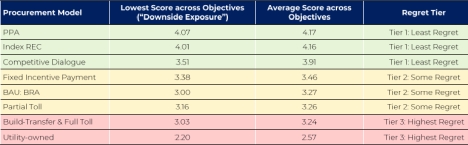 The MCDA analysis found that the Index REC, Competitive Dialogue, and PPA models perform the best in terms of resource adequacy
NEW Jobs on RetailEnergyJobs.com:
• NEW -- Enrollment & Rate Management Director - Retail Supplier
• NEW -- Strategic Sales Channels Manager - Retail Supplier
• NEW -- Controller - Retail Provider
• NEW -- Manager, Product I - VXRetail (Retail Energy)
• Refreshed 5/27/26 -- Manager, ISO Coordination (electricity), Retail Supplier
|
|
|
|
|