
|
|
|
|
|









Consumer Advocates Seek Cap On Retail Supplier Rates Under POR At Another Utility
The following story is brought free of charge to readers by VertexOne, the exclusive EDI provider of EnergyChoiceMatters.com
In a rate case at Peoples Natural Gas Company LLC in Pennsylvania, the Coalition for Affordable Utility
Services and Energy Efficiency in Pennsylvania (CAUSE-PA) has recommended that the PUC impose a rate cap on retail supplier plans in order for the receivables from such plans to be eligible for Peoples' purchase of receivables (POR) program
If such reform to POR is not adopted, CAUSE-PA said that the POR program should be terminated, arguing that no other modification to POR would protect customers from higher uncollectible costs due to POR
CAUSE-PA in a post-hearing brief specifically said in multiple instances that, under CAUSE-PA's proposal, to be eligible for POR, a retail supplier rate would need to be at or below the applicable default service price, "at the time of contract initiation or renewal."
However, in the brief, CAUSE-PA does not universally describe its proposal as specifically applying the price cap comparison to the default service rate as occurring only at the time of enrollment or renewal, as CAUSE-PA also states more generally that CAUSE-PA's proposal, "would
require all charges for contracts or renewals of contracts entered after that period [a proposed June 1, 2027 start of the cap] be at or below
the default service price to compare in order to have any charges after that date be included in the
POR program". [emphasis added]
CAUSE-PA proposes that retail suppliers with rates above the price to compare would still be permitted to use utility consolidated billing, but rates above the PTC would not be eligible for POR. Additionally, there would be no all-in/all-out rule for POR; a supplier would be permitted to use POR for the contracts which meet the proposed price cap, and the supplier would still have the ability to use UCB for non-eligible rate plans
As described in a brief, CAUSE-PA's price cap for POR would not be limited to residential service, though CAUSE-PA's concerns with pricing, and the associated data discussed below, are focused on residential customers
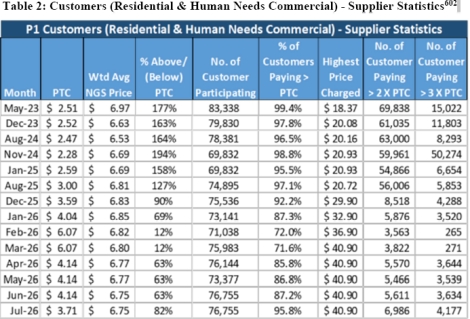
CAUSE-PA said that residential retail supplier rates have significantly exceeded the Peoples price to compare over an extended period dating back to May 2023, with CAUSE-PA showing such higher supplier rates in peak, off-peak, and shoulder months
CAUSE-PA cited some supplier rates which were as high as $40 per Mcf
Citing data from Peoples, CAUSE-PA said that, as
of July 2026, approximately 95.8% of residential shopping customers
pay more than the PTC, and the average supplier price is 82% above
the PTC -- with some supplier prices reaching as much as ten times the PTC.
CAUSE-PA stated, "Over the last three years, the percentage of residential shopping customers on Peoples’
system who paid more than the PTC ranged from 71.6% to 99.4%. The vast majority of
residential shopping customers were charged more than Peoples’ PTC for commodity supply, with
many paying two to three times as much -- with some charged more than $40 per Mcf. For
reference, the average Peoples PTC from January 2024 to April 2026 was $3.21 per MCF."
CAUSE-PA presented the following data comparing the PTC and retail supplier rates:
CAUSE-PA stated that, for the 28-month period from January 2024 through April 2026, write-offs for
Peoples’ residential shopping customers were 484% higher than for residential default service
customers -- amounting to an average write-off of $602.13 for residential shopping accounts,
compared to $124.31 for default service accounts
CAUSE-PA stated, "For low income shopping customers, write
offs are an astounding 853% higher than write offs for low income default service customers --
amounting to an average of $978.89 per low income shopping account, compared to $114.75 for
low income default service accounts."
"Higher collections costs and write-off expenses flow through to the uncollectible expenses paid
for by all ratepayers," CAUSE-PA stated
CAUSE-PA said, "Peoples POR program is causing rates to increase unnecessarily for all
customers through increased collections related costs. Over a 28-month period, from January 2024
through April 2026, Peoples’ residential shopping customers were charged $51.9 million more than
they would have otherwise would have been charged for default service. $7.4 million of that
amount was attributable to confirmed low income customers.
This breaks down to
approximately $683 per residential customer and $704 per confirmed low income customer."
The Retail Energy Supply Association has opposed CAUSE-PA's proposal in the rate case proceeding. A post-hearing brief from RESA was not publicly available as of publication time
Docket R-2026-3060855
ADVERTISEMENT Copyright 2026 EnergyChoiceMatters.com. Unauthorized copying, retransmission, or republication
prohibited. You are not permitted to copy any work or text of EnergyChoiceMatters.com without the separate and express written consent of EnergyChoiceMatters.com
Report: 96% Of Residential Shopping Customers Pay More Than Default Service At Utility; Avg. Retail Supplier Rate 82% Higher
Retail Supplier Rate As High As $40/Mcf
August 26, 2026
Email This Story
Copyright 2026 EnergyChoiceMatters.com
Reporting by Paul Ring • ring@energychoicematters.com
NEW Jobs on RetailEnergyJobs.com:
• NEW -- Enrollment & Rate Management Director - Retail Supplier
• NEW -- Strategic Sales Channels Manager - Retail Supplier
• NEW -- Controller - Retail Provider
• NEW -- Manager, Product I - VXRetail (Retail Energy)
• Refreshed 5/27/26 -- Manager, ISO Coordination (electricity), Retail Supplier
|
|
|
|
|